


Vasco de Gama and his team beginning for India.
Vasco da gama india journey: Vasco de Gama was a Portuguese sailor and explorer who has made its important place in history by finding a sea route for India in 1498. His visit was not only to promote trade between Europe and India, but it also changed the world history. When Vasco de Gama reached India, he considered Hindus as Christians, because he saw them doing idol worship. Earlier, Vasco de Gama had never seen any Hindu worshiping, so he had this misunderstanding. Come, let’s know about the story and effect of this special journey of Vasco de Gama.
Why did the countries of Europe want to reach India?
In the 15th century, the countries of Europe wanted to reach India and Eastern countries for spices, silk, and other precious things. At that time, spices, such as black pepper and cinnamon, were as precious as gold and silver in Europe. But their business was mostly in the hands of the merchants of Arab and Venice, who brought it to the ground. This path was tall, dangerous, and expensive. King Manuel I of Portugal decided to find a sea route so that there could be trade directly from India. Vasco de Gama was chosen for this work, an experienced sailor and courageous person.
Vasco left for India with 4 ships
Vasco de Gama started his first visit to India on 8 July 1497 from Lisbon, Portugal. He had 4 ships with him:
- Sao gabriel (main ship of Vasco)
- Sao Rafael (led by his brother Paulo de Gama)
- Baroo (a small ship)
- A supply ship (who was carrying the necessary items on the way)
There were about 170 people on these ships, including sailors, soldiers, and translator. His aim was to reach India by sea via Africa. This journey was very risky, as there was no complete knowledge of sea routes at that time.

Caravan of Vasco de Gama descending in Calicut, India.
Vasco was divided into many parts
The journey to Vasco was divided into many parts, and there were many difficulties.
1. first went to the west coast of Africa: Vasco first traveled to Cape Verde Islands. From here he took a bold decision. They went far in the Atlantic Ocean to avoid the dangerous winds and currents of the west coast of Africa. This part of the journey was about 3 months old, and during this time the sailors faced food and water scarcity.
2. Cape of Good Hope crossed: In November 1497, Vasco’s fleet reached the Cape of Good Hope of Southern Africa. This sea route was very dangerous, as there were strong storms and high waves here. Nevertheless, Vasco crossed it and moved towards East Africa.
3. Facing obstacles in East Africa: In East Africa, Vasco suffered opposition from several local rulers and traders. Local people and Arab traders in Mozambique and Mombasa did not rely on the Portuguese, as they were looking at their business in danger. In Malindi, however, Vasco found a friendly Sultan, who helped him an experienced sailor, Ahmed Ibn Majid. This sailor knew the sea route of India well.
4. I stepped on India’s soil in 1498: On 27 May, 1498, Vasco de Gama’s fleet reached Calicut (today’s Kozhikode, Kerala). This was the first time an European came to India by sea route. Calicut was a large trading center of spices at that time, which was ruled by Jamorin (local king).
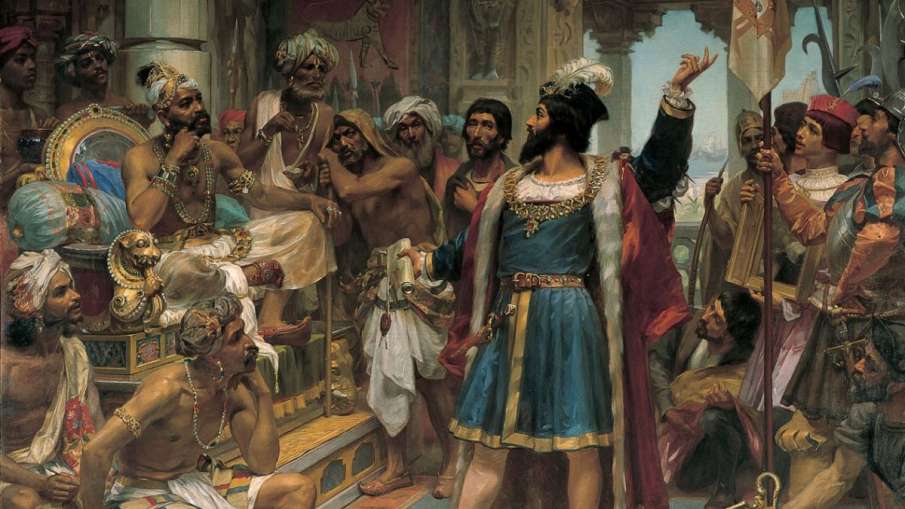
Meeting of Vasco de Gama and Jamorin.
People made fun of Vasco in Calicut
Vasco received mixed welcome in Calicut. Vasco gave some cheap gifts to Jamorin, such as clothes and caps. Local people made fun of them as they were expecting precious items like gold, silver, and spices. Arab traders who traded from Calicut considered the Portuguese as enemies, as they could eliminate their spice trade. He tried to provoke Jamorin against Vasco. Once, Arab traders also conspired to attack Vasco’s ships, but Vasco was alert and escaped.
Vasco understood the temples of Hindus as a church
When Vasco reached India, he felt that the Hindu temple of Calicut is a Christian church, because he saw the idols there. He considered the local people as ‘non-traditional Christians’. Actually, before this he had never seen Hindus worshiping. He faced only Christians and Muslims and developed his understanding on this basis.
What was the effect of Vasco’s journey on the world?
Vasco spent a few months in Calicut and bought spices such as black pepper and cinnamon. Out of the four vessels in Vasco, only two Portugal returned, and only 55 people out of 170 survived. His visit had a profound impact on the history and society of India. Vasco’s visit opened the way for European powers (Portugal, then Dutch, English, and French) to India. The Portuguese captured areas like Goa, Daman, and Diu and built their settlements there. The visit started cultural exchange between Europe and India. The Portuguese began propagating Christianity in India, and Indian spices, clothes, and culture reached Europe.
Latest india news
